
A Reych with two dates
On December 5th, 1890 the Nova Yorkia (69) founded a colony in Newark. A year and a half later, on April 22nd, 1892, it was raised to a Reych. The celebration took place in Burg Centralia — named after the Central Railroad Hotel at the terminus, a textbook German clubhouse. Both dates belong together: the Reych itself counts from the first and kept its 136th Founding Festival on 30 November 2026.
The cover that answers everything
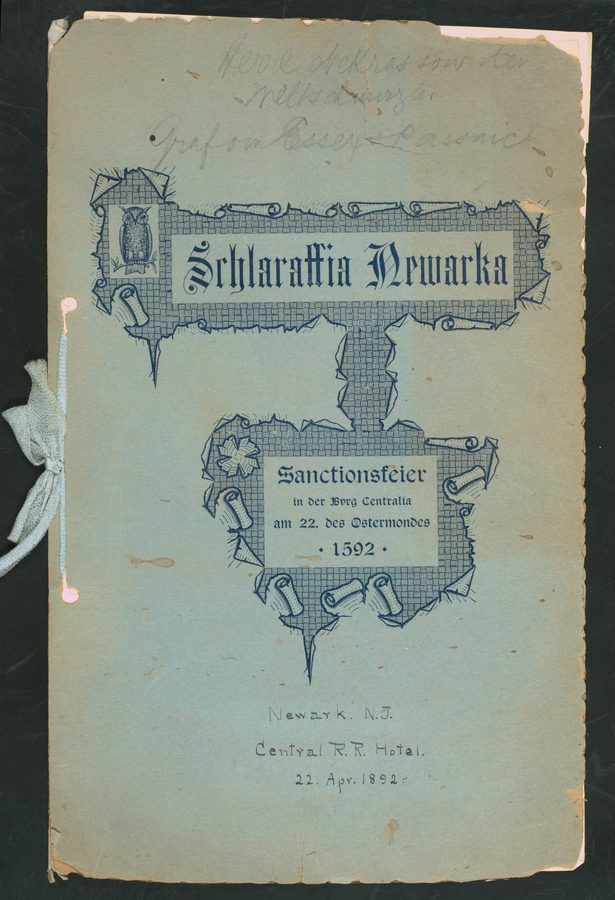
From the evening of the Sanctionsfeyer one witness survives, and a splendid one: a booklet of sixteen pages, blue cover, tied with a ribbon. It lies in the Rare Book Division of the New York Public Library, in the Buttolph collection of menus. On the cover, printed in blue, with an owl in a box, it reads:
Schlaraffia Newarka · Sanctionsfeier in der Bvrg Centralia am 22. des Ostermondes · 1592 ·
The year 1592 is the Schlaraffian joke — the Reych dates itself three hundred years back, as the game requires. Beneath it, added in pen by the collector Frank Buttolph, stands the real date: Newark, N.J. · Central R.R. Hotel · 22 Apr. 1892. Two names in pencil record who was there that evening: Herrl. Nekrassow der Weltschmerzer and Graf von Essex Passaic — the second carries two local references at once, for Essex is the county of Newark and the Passaic is its river.
The Atzvngs-Zeddel
The booklet holds five song sheets in Fraktur — Lulu Praga, the Schlaraffen-Hymne, the Schlaraffen-Schöpfung, the Lulu-Lied and the Urschlaraffenlied — and the bill of fare. It is no ordinary menu but a piece of Reych art. Above the list, instead of In arte voluptas, stands the pun In brandio volvptas, and under every course a line from one of the songs in the same booklet.
You have to know the jokes: Avstreae Pvncti azvli are Blue Point oysters, Sommerinselnknollen are Bermuda potatoes — Bermuda was once the Somers Isles —, Kasvs im Belli is cheese, Arabische Bohnenbrühe is coffee and Lvnten are cigars. At the foot it reads: Ad memorandum: Die Interstices werden mit seyn Geredt und Leibe ausgefüllet — the pauses between courses are to be filled with speech and with fencing. Whoever puts such a note on the table at his own Sanctionsfeyer did not learn the game the night before.
A second piece of evidence lies on the other side of the Atlantic: in the Geheimes Staatsarchiv Preussischer Kulturbesitz in Berlin, holding Rep. 227 keeps the invitation to the Sanctionsfeyer of the Reych Newarka on April 22nd, 1892 — it got there because the Oldenburgia received it at the time and kept it. The Newarka had invited Germany.
From Newark to Dover
When the German community left Newark and moved west into Morris County, the Reych moved with it. Burg Centralia by the railway station became the Trutze Passaica in Dover. Both names hold Newark fast — the one through the hotel, the other through the river.
Schlaraffia in the United States has come through two hard breaks, the First World War, when everything German fell under suspicion, and the Second. Of the generation and the region of the Newarka, the Nova Yorkia, the Caesarea, the Ludovica Missouria, the Baltimora and the SyracUHUsa have gone out. That a Reych sanctioned in 1892 still sipps on Mondays is not a matter of course; it is an achievement.
In good company
The Newarka is one of the eight Reyche of the Order Stern des Nordatlantik, which is given to whoever visits them all: Newarka, Brooklynia, Filadelfia, Bostonia, Totowa, Bisonia, Washingtonia and Porta Ontariae.
History of Schlaraffia
🦉 Schlaraffia in figures: founded 1859 · over 200 Reyche worldwide · 5 continents · one language · one spirit: humour, friendship and art.
The cradle: Prague, 1859
It began with a handful of artists and men of letters in the Prague of 1859. Actors, poets, painters — people who wanted to set the gravity of the times aside for a few hours in order to laugh, to play and to keep friendship together. They simply called their circle Schlaraffia.
The name was the programme: the fabled land of Cockaigne, that country of lightness and joy, was to become real for a few hours. No class distinctions, no everyday hierarchies — only play, humour and art.
The game spreads
The idea travelled fast. Soon further Reyche arose in other cities of the German-speaking world: Vienna, Berlin, Hamburg, Munich. With the wave of German emigration in the nineteenth and early twentieth centuries, Schlaraffia crossed to the New World as well.
New York, Buenos Aires, São Paulo — wherever German-speaking emigrants found a new home, they founded a Schlaraffen-Reych too. The bond of a shared language and a shared game held them together, across every distance.
Schlaraffia survives the storms of history
Two world wars, political upheavals, prohibitions — Schlaraffia has come through much. In Germany and Austria the work of the Reyche was restricted or forbidden during the war years. But as soon as peace returned, the Reyche came back to life. That will to endure is no accident: where real friendship rules, it finds a way.
Worth noting: while in Europe some Reyche paused for a time, Schlaraffia overseas carried on unbroken. The Allschlaraffia — the worldwide umbrella — held the whole together.
The Allschlaraffia — the worldwide union
All the Schlaraffen-Reyche of the world are joined in the Allschlaraffia. This umbrella sets the common rules, assigns the Reych numbers and sees to it that a Schlaraffe from Tokyo is at home at once in a Sippung in Frankfurt.
In doing so the Allschlaraffia keeps up something that has grown rare in the modern world: a fellowship founded on values rather than on profit or networking. Humour, friendship and art are not empty words here; they are practised at every Sippung.
Become part of our history?
Write the next chapter with us. A visit without obligation is enough.
Stand dieser Seite: